Is Congress tap water safe to drink?
- Congress CCD, AZ
- Congress
The short answer for Congress
Recent public test data for Congress is limited. Check local utility reports and monitor updated EPA records for the latest water quality information.
The health risk for Congress
No specific notes available.
Certified filtration options for common tap-water contaminants.
| Compound | Measurement | EPA Limit | Comparison |
|---|---|---|---|
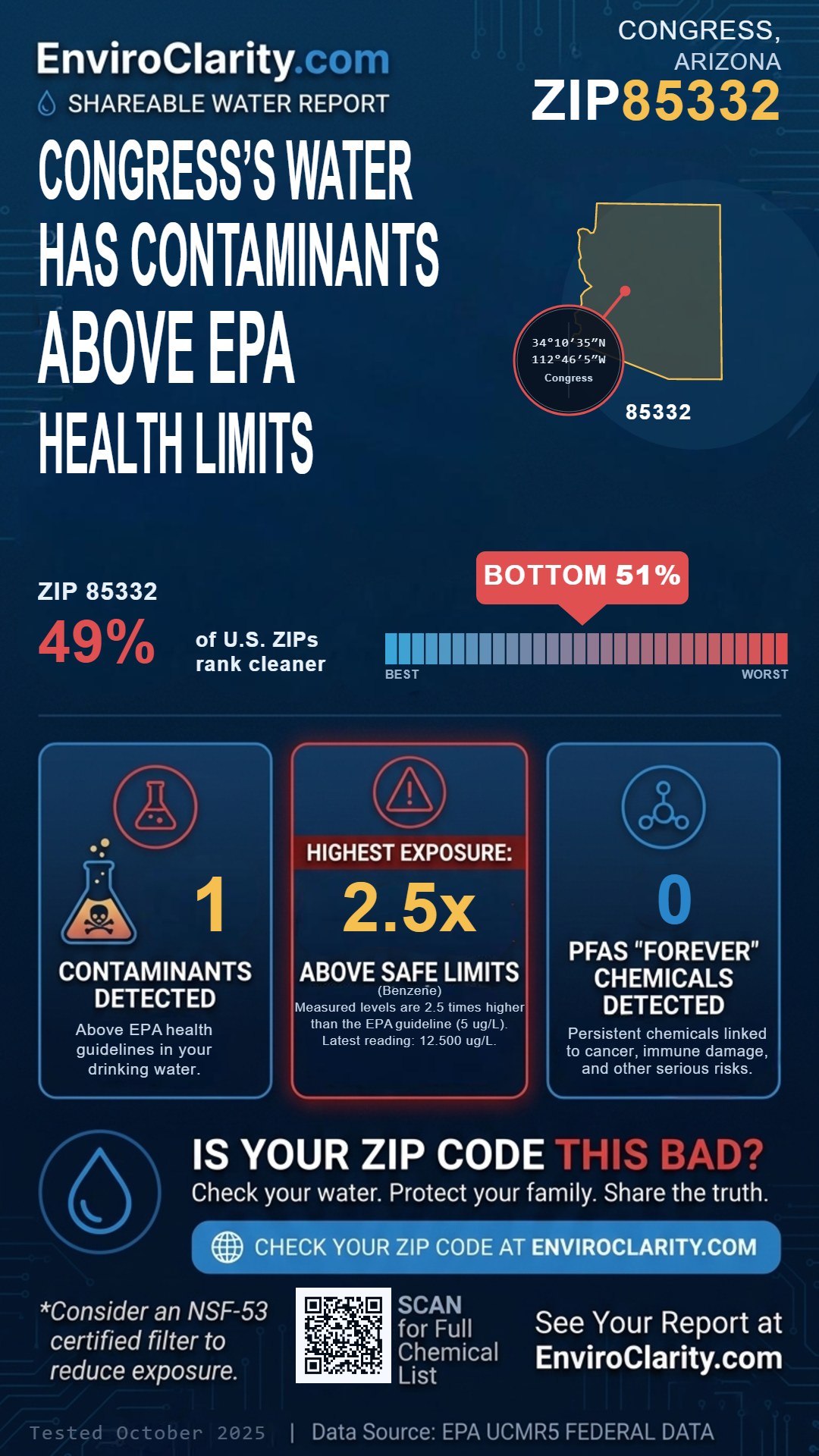
| Benzene Tested: October 2025 · 82070 |
12.500 µg/L | 5 µg/L | 150% above limit |
View all tested compounds
82070 · Tested: Multiple dates
| Compound | Measurement | EPA Limit | Comparison |
|---|---|---|---|
| Benzene | 12.500 µg/L | 5 µg/L | 150% above limit |
| 1,2-Dichloroethane | 2.480 µg/L | 5 µg/L | 50% of limit |
| Toluene | 7.130 µg/L | 1000 µg/L | 0.7% of limit |
| 1,2,3-Trimethylbenzene | 9.910 µg/L | — | — |
| 1,2,4-Trimethylbenzene | 238.000 µg/L | — | — |
| 1,3,5-Trimethylbenzene | 87.500 µg/L | — | — |
| 2-Chloronaphthalene | 0.120 µg/L | — | — |
| 2-Methylnaphthalene | 91.500 µg/L | — | — |
| Acenaphthene | 0.272 µg/L | — | — |
| Acenaphthylene | 0.054 µg/L | — | — |
| Acetone | 51.100 µg/L | — | — |
| Anthracene | 0.064 µg/L | — | — |
| Carbon disulfide | 0.115 µg/L | — | — |
| Chlorobenzene | 0.509 µg/L | — | — |
| Cumene | 18.200 µg/L | — | — |
| Cyclohexane | 30.900 µg/L | — | — |
| Ethylbenzene | 218.000 µg/L | — | — |
| Fluorene | 0.025 µg/L | — | — |
| Hexane | 22.100 µg/L | — | — |
| Isopropyl ether | 139.000 µg/L | — | — |
| Methyl isobutyl ketone | 5.460 µg/L | — | — |
| Methyl tert-butyl ether | 850.000 µg/L | — | — |
| Methylcyclohexane | 34.100 µg/L | — | — |
| Methylene chloride | 10.600 µg/L | — | — |
| n-Butylbenzene | 1.360 µg/L | — | — |
| n-Propylbenzene | 31.400 µg/L | — | — |
| Naphthalene | 126.000 µg/L | — | — |
| o-Chlorotoluene | 22.700 µg/L | — | — |
| p-Cymene | 0.354 µg/L | — | — |
| p-Dichlorobenzene | 0.680 µg/L | — | — |
| p-Ethyltoluene | 10.700 µg/L | — | — |
| Phenanthrene | 0.112 µg/L | — | — |
| Propylene | 1.780 µg/L | — | — |
| Pyrene | 0.017 µg/L | — | — |
| sec-Butylbenzene | 4.480 µg/L | — | — |
| Styrene | 0.621 µg/L | — | — |
| tert-Butylbenzene | 0.254 µg/L | — | — |
| Tribromomethane | 0.133 µg/L | — | — |
| Xylene | 319.000 µg/L | — | — |
Water utilities serving ZIP 85332
Service area boundaries are approximate and based on state filings or modeled estimates. Contact your utility to confirm exact service at a specific address.
- 82070 (WQP)No recent federal sampling
Frequently Asked Questions about ZIP 85332 Tap Water
What's in ZIP 85332 tap water?
Recent public test data for ZIP 85332 is limited. Check your local utility's Consumer Confidence Report for the most current information.
Who provides tap water in ZIP 85332?
Public records identify 82070 (WQP) as a primary water system associated with ZIP 85332. Service boundaries can vary by address, so confirm exact service with the utility.
When was ZIP 85332 tap water last tested?
The most recent test date used in this report is Unknown. EnviroClarity last refreshed this page on 2026-05-05.
Where can I find the official water quality report for ZIP 85332?
Every U.S. public water system is required to publish an annual Consumer Confidence Report (CCR). Contact 82070 (WQP) or visit their website for the latest official report covering ZIP 85332. The EPA also maintains a national CCR locator.
Do I still need a water filter in ZIP 85332?
Even when EPA-tracked compounds are within limits, some households use a certified filter for taste, odor, or to add a margin against trace contaminants below the reporting limit. Match any filter's certifications (NSF/ANSI 42, 53, 58, or P473) to the specific compounds you care about.
Check another ZIP code
Nearby ZIP reports
- 85362 - Yarnell tap water report
- 85390 - Wickenburg tap water report
- 85342 - Congress CCD, Surprise tap water report
- 86343 - Crown King tap water report
- 85361 - Buckeye, Surprise tap water report
- 85320 - Aguila tap water report
- 86303 - Prescott Valley, Prescott tap water report
- 86302 - Prescott tap water report
Data reflects publicly reported utility records from EPA datasets and local utility disclosures. This information is educational and not medical advice.