Is Rock Springs tap water safe to drink?
- Rock Springs South CCD, WY
- Rock Springs North CCD, WY
- Wamsutter CCD, WY
- Rock Springs
The short answer for Rock Springs
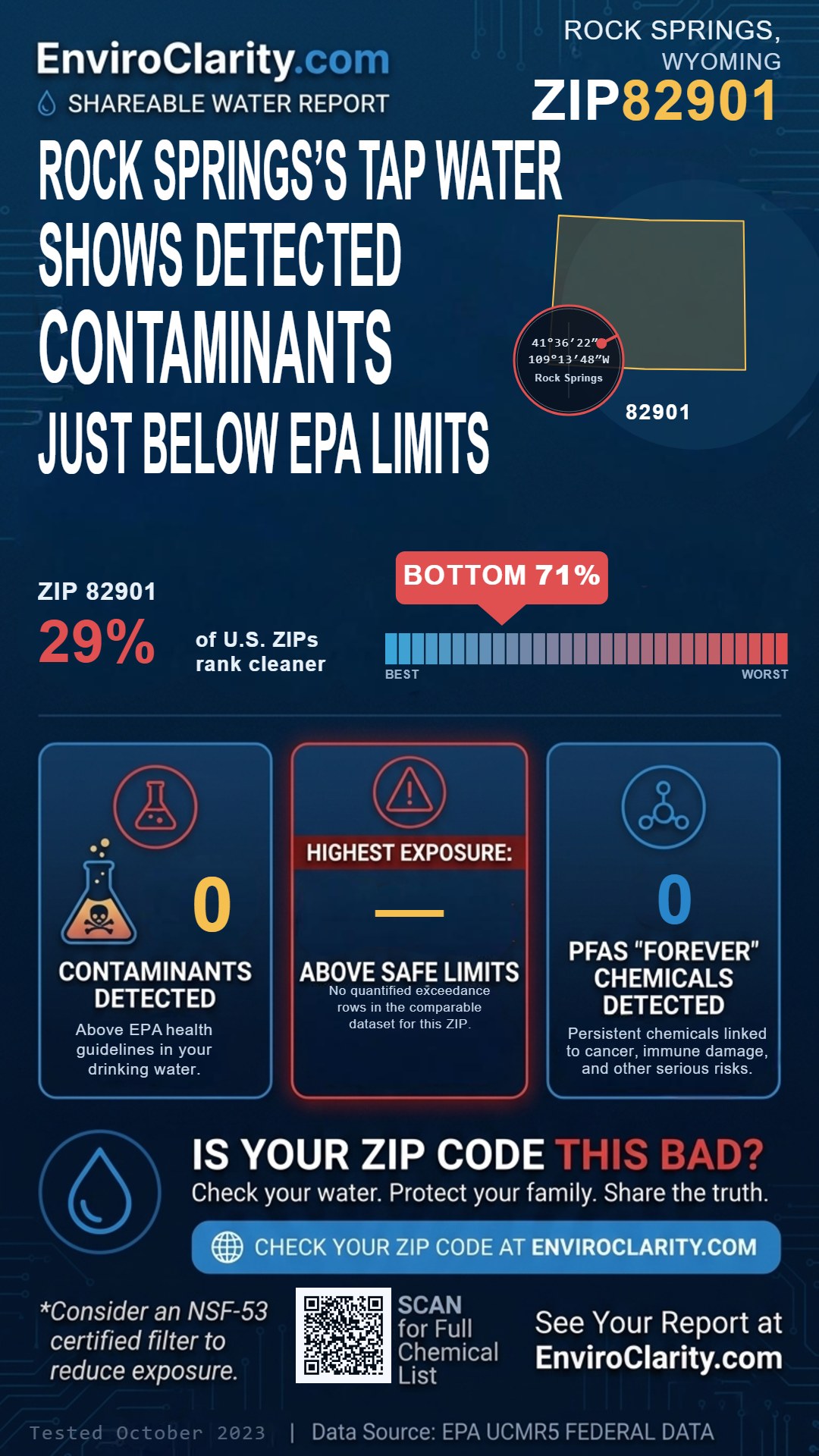
Rock Springs tap water has 1 detected contaminant, currently below EPA limits (tested October 2023). lithium measured closest to the threshold. See the full compound-by-compound report.
The health risk for Rock Springs
- PFAS or other chemicals detected; no confirmed exceedances in multiple samples.
lithium was detected below EPA limits. A certified filter can still add an extra layer of protection.
Here's what actually removes PFAS from your water
The right filter eliminates PFAS at the tap. But not all filters do - and the type you choose matters for your home.
Common pitchers like Brita do not remove PFAS. You need a filter independently certified to NSF P473 (for pitcher filters) or NSF/ANSI 58 (for reverse osmosis systems). All three options below carry the relevant certification.
| Compound | Measurement | EPA Limit | Comparison |
|---|---|---|---|
| lithium Tested: October 2023 · Rock Springs/Green River JP Intertie |
9.500 µg/L | 10 µg/L | 95% of limit |
View all tested compounds
Rock Springs/Green River JP Intertie · Tested: October 2023
| Compound | Measurement | EPA Limit | Comparison |
|---|---|---|---|
| lithium | 9.500 µg/L | 10 µg/L | 95% of limit |
| PFHxS | <0.003 µg/L | 0.004 µg/L | Below limit |
| HFPO-DA | <0.005 µg/L | 0.01 µg/L | Below limit |
| PFNA | <0.004 µg/L | 0.01 µg/L | Below limit |
| PFHxA | <0.003 µg/L | 3 µg/L | Below limit |
| PFBA | <0.005 µg/L | 6 µg/L | Below limit |
| 11Cl-PF3OUdS | <0.005 µg/L | 0.005 µg/L | Below limit |
| 4:2 FTS | <0.003 µg/L | 0.003 µg/L | Below limit |
| 6:2 FTS | <0.005 µg/L | 0.005 µg/L | Below limit |
| 8:2 FTS | <0.005 µg/L | 0.005 µg/L | Below limit |
| 9Cl-PF3ONS | <0.002 µg/L | 0.002 µg/L | Below limit |
| ADONA | <0.003 µg/L | 0.003 µg/L | Below limit |
| PFBS | <0.003 µg/L | 0.003 µg/L | Below limit |
| PFDA | <0.003 µg/L | 0.003 µg/L | Below limit |
| PFDoA | <0.003 µg/L | 0.003 µg/L | Below limit |
| PFHpA | <0.003 µg/L | 0.003 µg/L | Below limit |
| PFHpS | <0.003 µg/L | 0.003 µg/L | Below limit |
| PFOA | <0.004 µg/L | 0.004 µg/L | Below limit |
| PFOS | <0.004 µg/L | 0.004 µg/L | Below limit |
| PFPeA | <0.003 µg/L | 0.003 µg/L | Below limit |
| PFTrDA | <0.007 µg/L | 0.007 µg/L | Below limit |
| PFUnA | <0.002 µg/L | 0.002 µg/L | Below limit |
Water utilities serving ZIP 82901
Service area boundaries are approximate and based on state filings or modeled estimates. Contact your utility to confirm exact service at a specific address.
- ROCK SPRINGS, CITY OFSome concern
Frequently Asked Questions about ZIP 82901 Tap Water
What's in ZIP 82901 tap water?
ZIP 82901 has 1 detected contaminant below EPA limits in this dataset. lithium measured closest to its guideline.
Will boiling ZIP 82901 tap water remove lithium?
No. Boiling tap water does not remove lithium. Lithium is a dissolved mineral, so heat does not break it down and evaporation can actually concentrate it. Reverse osmosis (NSF/ANSI 58) is the most reliable at-home option for reducing lithium.
Do basic pitcher filters remove lithium?
Standard pitcher filters are not certified to reduce lithium. Reverse osmosis (NSF/ANSI 58) is the most widely available home option for reducing lithium in drinking water.
Who provides tap water in ZIP 82901?
Public records identify ROCK SPRINGS, CITY OF as a primary water system associated with ZIP 82901. Service boundaries can vary by address, so confirm exact service with the utility.
When was ZIP 82901 tap water last tested?
The most recent test date used in this report is October 2023. EnviroClarity last refreshed this page on 2026-05-05.
Where can I find the official water quality report for ZIP 82901?
Every U.S. public water system is required to publish an annual Consumer Confidence Report (CCR). Contact ROCK SPRINGS, CITY OF or visit their website for the latest official report covering ZIP 82901. The EPA also maintains a national CCR locator.
Check another ZIP code
Nearby ZIP reports
Data reflects publicly reported utility records from EPA datasets and local utility disclosures. This information is educational and not medical advice.